Prevention from Suicide, Addiction, Narcotics and Pollution. Withdrawal and Recovery Facts of Narcotics | Symptoms of Suicidal thoughts & Ideations | Effects of Environment Pollution | Understand Addiction withdrawal
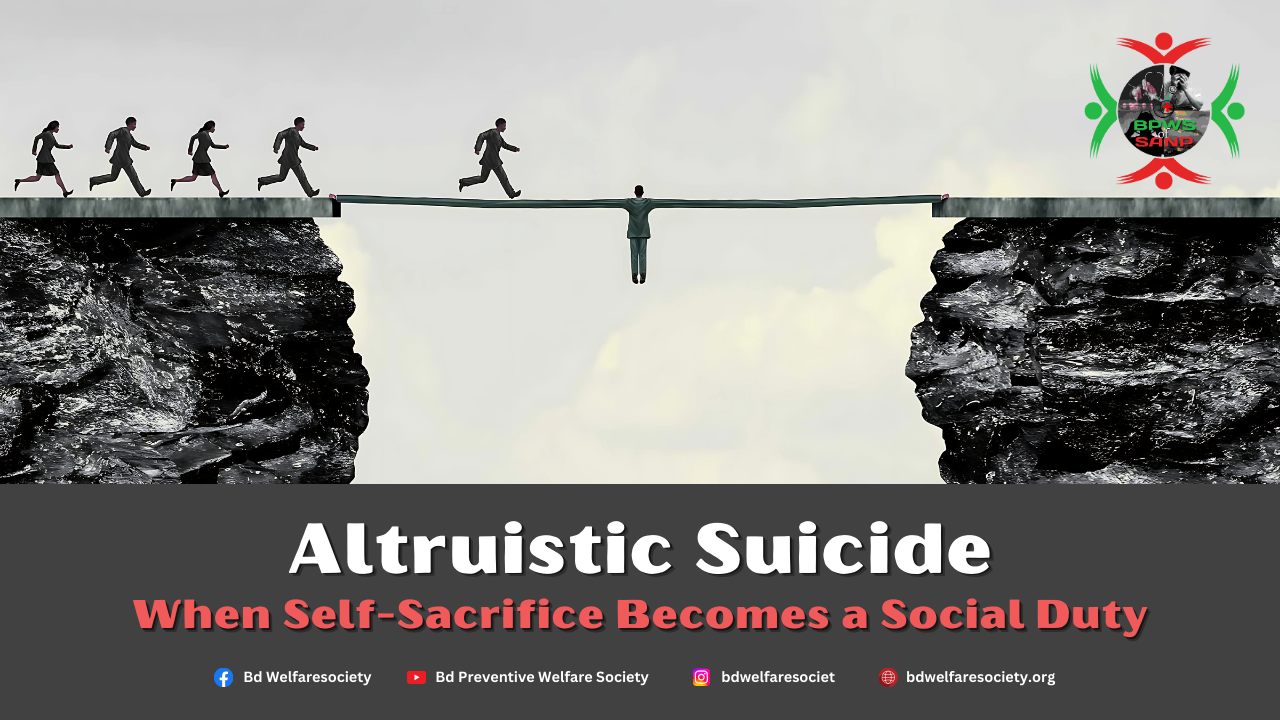
What is an example of altruistic suicide? Is it courage, duty, or something deeper? This question is at the root of the phenomenon of altruistic suicide, a term coined by French sociologist Émile Durkheim in his seminal work Suicide (1897). In this article we’ll dissect what altruistic suicide is, examples across history and today, and what social forces push some to commit extreme acts of self-sacrifice. By the end you’ll come away with a fuller idea of the ways that individual behavior is shaped by the collective values around it, and the concept of human morality as a more complicated thing.
The Roots of Selflessness and Self-Sacrifice
To explain altruistic suicide, we need to look to Émile Durkheim, the founding father of sociology. Unlike the psychologists of his day, who viewed suicide through the lens of individual psychobiology, Durkheim looked at suicide as a form of social action with social-structural causes. He singled out four suicide types: egoistic, altruistic, anomic, and fatalistic.
Altruistic suicide happens when people feel so intensely connected to a group or society that they deem the group’s well-being is more important than their own life. Is this a case of “suicide? This suicide is motivated by duty, honor, or what he/she believes is a legal or moral obligation. Durkheim contended that in very cohesive societies, groups tend to supersede individual identities, and so acts of self-sacrifice do occur.
Acronyms of Altruistic Suicide:
- Deep Sense of Group Identity: The last person has a profound sense of being part of some niche community.
- Duty: The act is undertaken with the intention of benefiting the of the group, and there is often a moral obligation to do so.
- Civic Acceptance: Sometimes the act is socially approved or even celebrated.
Examples of Altruistic Suicide in History
Indeed, altruistic suicide has taken on different shapes throughout history, often culturally, religiously or politically contextualized. Let’s take a look at some of the best examples.
- Seppuku in Samurai Culture
One of the most famous instances of altruistic suicide is in the custom of seppuku (or harakiri) in Japanese samurai culture. It was a ritual form of suicide practiced by samurai who dishonored themselves or their lords. They killed themselves to bring back honour to their family or their clan. It is being viewed as a measure to follow the values of the society, and to keep their social conscience intact.
- Find out more about Kamikaze Pilots in World War II
Japanese kamikaze pilots flew into enemy targets during World War II as suicide missions. Often these pilots were young men persuaded that their deeds would defend their country and guarantee Japan’s victory. It was a sacrifice before God and country, steeped in the patriotic duties of the ideological and the cultural zeitgeists.
- Early Christian Martyrs
When the first Christians came into the world there was a remarkable willingness to face death rather than deny faith. They were the martyrs, heroes who gave their lives for the benefit of their co-religionists. Their deaths, too, were celebrated as acts of supreme devotion and bravery.
Contemporary Forms of Altruistic Suicide
So, when altruistic suicide is used, practically everybody must be aware that this political climate is rooted in history.
- Suicide Bombings
Suicide bombings are one example of altruistic suicide in modern culture (12). Those who commit such acts are often motivated by ideological, religious, or political convictions. They view their actions as a means to further a cause or defend their community, even at the expense of their own lives. Yet this phenomenon gives rise to complex ethical questions surrounding coercion, manipulation and the very nature of altruism itself.
- Soldiers and First Responders
Today’s soldiers, firefighters, and first responders also put their lives on the line to save others. It is sometimes with full knowledge that they enter situations where survival might be impossible. But for example, a soldier who jumps on a grenade to protect others, a firefighter who rushes into a building that is on fire to save trapped civilians, etc. While heroic deeds are often seen in this manner, this altruism is also a response to a deep sense of duty and loyalty.
- Debates on Altruism
Not all self-sacrificial actions are universally perceived as altruistic. Critics of these conspiratorial interpretations point to a range of societal pressures that can lead someone to abhor a group, including ideological indoctrination, and in some cases, mental health issues. Questions, then, as to the divide between true generosity and outside interference.
The psychology and sociology of altruistic suicide
In order to get a complete understanding of altruistic suicide, we need to look at both psychological and sociological aspects.
Psychological Perspective
Psychologically, altruistic suicide is highly indicative of a sense of identity and positive self-image — a sense of belonging to the community. They just believe the sacrifice is going to help someone else. Cultural narratives that privilege self-sacrifice and duty often bolster this mindset.
Sociological Perspective
At a sociological level, altruistic suicide illustrates the impact of social integration and shared values. In societies with high cohesion, the individual’s identity is often embedded in the identity of the group. It can help establish a moral framework in which self-sacrifice is not merely accepted but anticipated.
Ethical Questions
Altruistic suicide raises difficult ethical questions. Is it moral to die for the good of others? Where is the line between interest of the individual versus community? These questions stay at the heart of arguments over altruism and self-sacrifice.
Criticisms and Controversies
Durkheim’s theory of altruistic suicide, though insightful, is not without its criticisms.
- Criticism of Durkheim’s Theory
Other scholars believe this is too simplistic and that Durhen’s schema is an oversimplification of suicide motivations.
In the case of contemporary suicide attacks, they have become so infused with elements of altruism, coercion, and ideological programming that it is hard to label them as simply altruistic.
- Cultural Relativism
Different cultures have different tolerance levels for altruistic suicide. Such acts are consider honorable in some societies and stigmatize in others.
As long as altruistic suicide (and, I would argue, all suicide) is subject to continued cultural relativism, it remains difficult to truly know what altruistic suicide is and what it means to a group.
- Ethical Dilemmas
The idolization of self-renunciation can be taken to perverse extremes of exploitation or coercion. For example, altruistic suicide of young people with their heads filled with the idea that this is the only way out.
Such suggestions also raise profound ethical questions about the extent to which society should influence individual education.
Conclusion
It is a complex and multifaceted phenomenon that defies our human nature. From the ritual suicides of the samurai through to the 21st-century sacrifices of soldiers and first responders, these acts are demonstrative of the power of the influences of society and macro identity.
Though these figures are often considered noble or heroic, they also pose important ethical questions regarding the balance between individual rights and the greater good.
And so we come full circle back to altruistic suicide: Is it an admirable act of selflessness? Depending on one’s cultural, historical and personal view, there may be different answers, but one would have to agree that altruistic suicide amplifies the relationship between individuality and society.